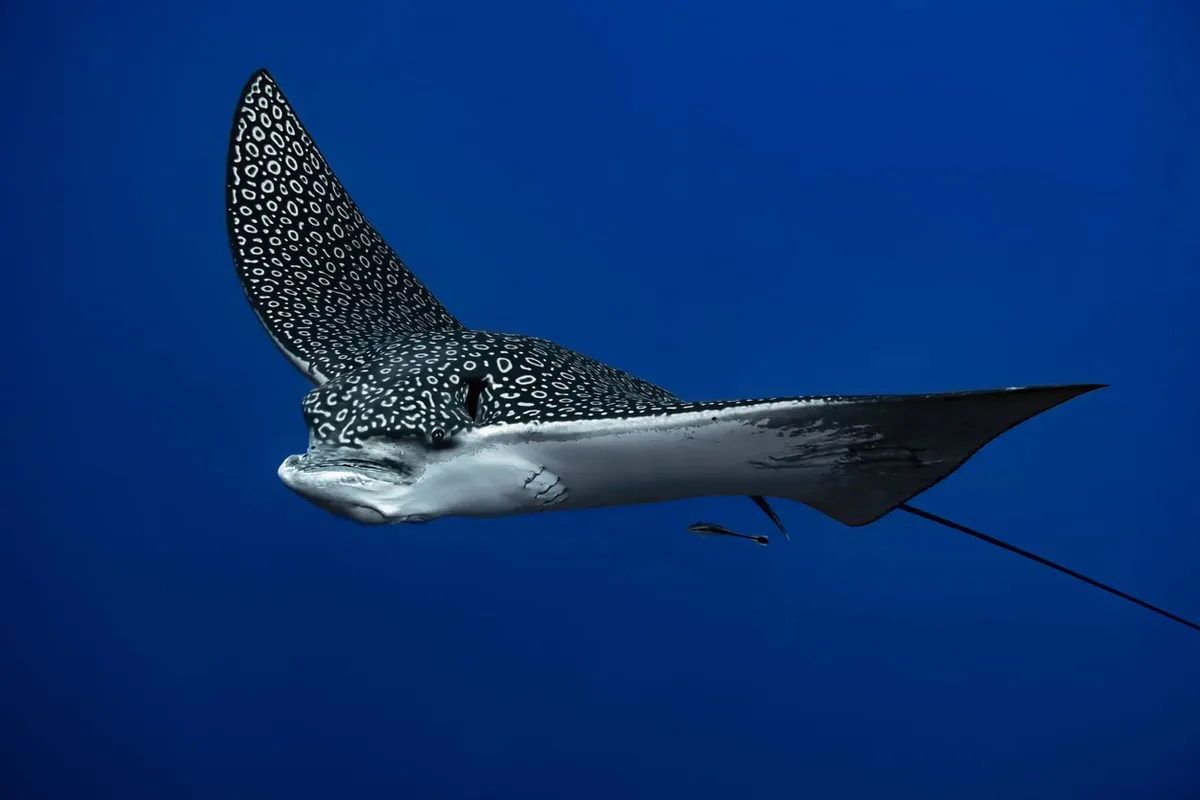
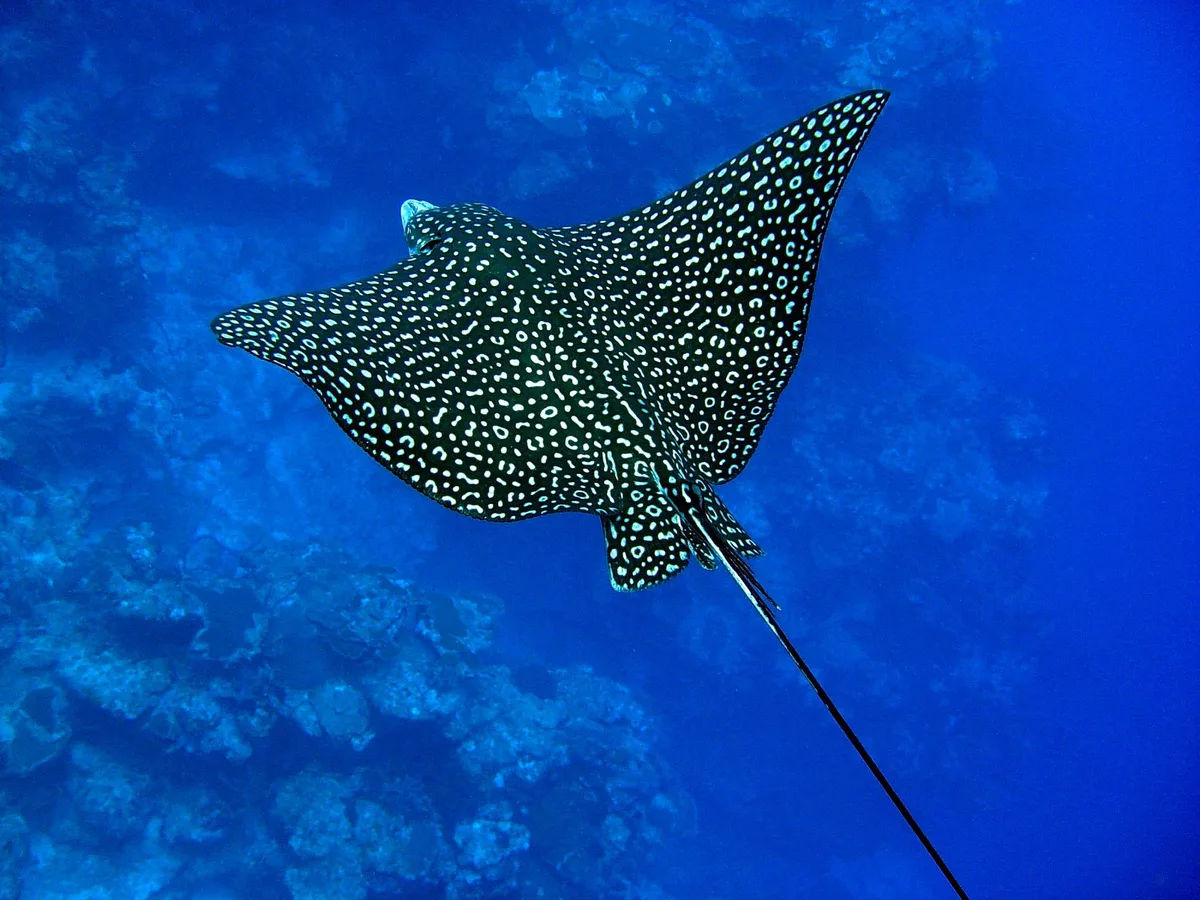
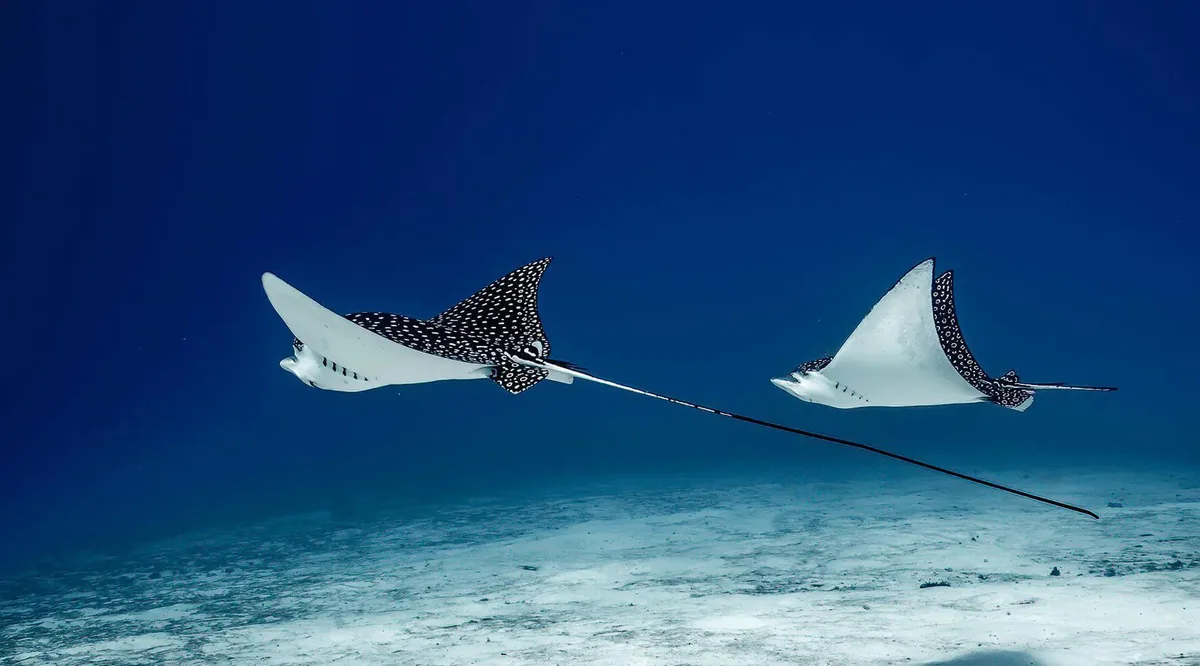
The Spotted Eagle Ray is highly susceptible to a variety of inshore demersal fisheries, including trawls and gillnets. Significant risks to the species are posed by its large size, preference for inshore habitats and coral reefs and hence availability to a wide variety of inshore fishing gear (e.g., beach seine, gillnet), and the generally intense and unregulated nature of inshore fisheries across most of its range. The Spotted Eagle Ray is also occasionally reported as non-target catch in bather-protection gillnets deployed off eastern Australia; mortality is estimated at 16% but any effects on the local population are unknown (Broadhurst and Cullis 2020).
There is a high level of fisheries resource use across most of the range of the Spotted Eagle Ray. Throughout the East China Sea and Southeast Asia, heavy exploitation levels, intensive fishing, and growing demand for fish consumption has caused declines in fish stocks, and a reduction in fish size and their trophic levels; the ‘fishing down’ effect from 1979 to 2014 is one of the highest estimated globally (Heileman and Tang 2009, Liang and Pauly 2017). In the East China Sea, over 30% of the catch now consists of fish that are too small for human consumption but are still retained to produce fish meal (Cao et al. 2015, Liang and Pauly 2017). In the territorial waters of countries including Viet Nam, Thailand, and Cambodia, most fisheries are now considered overexploited, where fishing effort has been increasing since 1950 across subsistence, artisanal, and industrial fisheries (Pauly et al. 2020).
Eagle rays were previously marketed in considerable numbers in Thailand and Malaysia (Compagno and Last 1999), but some species are now very rarely landed (Araujo et al. 2020, Rigby et al. 2020). Indonesia catches the highest number of chondrichthyans in the world with sharks and rays an important resource and the main livelihood for some communities (Sadili et al. 2015). Since 2016, ray catches have overtaken shark catches and now comprise approximately 60% of reported shark and ray catches (Prasetyo et al. 2021). Between 2005 and 2018, eagle rays made up 8% of ray production across Indonesia (Prasetyo et al. 2021). The Spotted Eagle Ray is landed throughout Indonesia and is one of the primary species caught in the rhynchobatid tangle net fishery (White et al. 2006, D'Alberto et al. 2022). Net and trawl fisheries in Indonesia (especially the Java Sea) and elsewhere are very extensive and as a result, many shark and ray species are highly exploited and stocks of most species have declined by at least an order of magnitude (Blaber et al. 2009).
Across the northern Indian Ocean, fishing effort is increasingly intense and largely unregulated. For example, there were about 6,600 trawlers operating in the Indian state of Gujarat in the early 2000s (Zynudheen et al. 2004). This number increased to 9,905 by 2016 and across all of India, 30,772 trawlers and 6,548 gillnetters were operating in 2016 (CMFRI_FSI_DoF 2020). In the Saudi Red Sea, the number of traditional vessels operating more than tripled from about 3,100 to 10,000 between 1988 and 2006 (Bruckner et al. 2011). Fisheries in the Red Sea are primarily small-scale and artisanal vessels fish primarily in nearshore coastal waters using a range of fishing gears including traps, gillnets, hook-and-line, and longlines (Tesfamichael et al. 2012, Jabado et al. 2017). Yemen is one of the largest shark fishing nations in the world by reported catch (Dent and Clarke 2015), however the total biomass and number of species landed in Yemen from the Red Sea is unknown due to a lack of species-specific reporting (Spaet et al. 2012, Jabado and Spaet 2017). In Iran, the Spotted Eagle Ray is rarely observed in trawl fisheries operating in the Persian Gulf (e.g., Raeisi et al. 2011, Paighambari and Daliri 2012), or in the stingray-targeted gillnet fishery in the Gulf of Oman, where about 6,500 t (roughly equal to two million individuals) of rays are landed at approximately 50 landing sites (Rezaie-Atagholipour et al. 2022).
Across the Western Indian Ocean (WIO), more than 60 million people reside within 100 km of the coast and there is great dependence on marine resources for food and employment (Obura et al. 2017). Marine fisheries catch in the WIO reported to the Food and Agriculture Organization (FAO) increased from the 1960s to the 1990s but have levelled off since 1999 suggesting stocks are fully fished. Artisanal catches are underreported and most small-scale, artisanal, and subsistence coastal fisheries within the WIO are considered to be fully- or overexploited, especially where they are found close to population centres (Obura et al. 2017). Information on sharks and rays in the WIO is limited. Landings have often not been reported to the species level (Marshall and Barnett 1997, Temple et al. 2018) and monitoring at major landing sites (including those in Tanzania and Kenya) only commenced around 2018 (Bennett et al. 2023). However, fisheries have been intensive and extensive throughout the region. Inshore fisheries deploy non-selective gears such as gillnets and beach seines, and drift gillnets are often used to target sharks and demersal gillnets to target rays (Kiszka 2012, Temple et al. 2018, Temple et al. 2019, Osuka et al. 2021). Eagle rays have been reported as both targeted catch and bycatch in many nations (Marshall and Barnett 1997, Temple et al. 2018, Nevill 2019). Off Mozambique, 92% of landings from the beach seine fishery, the primary small-scale fishery which accounted for nearly all shark and ray landings reported in 2014, were reportedly of the Spotted Eagle Ray (Temple et al. 2018). Eagle rays are also targeted by spearfishers (Nevill 2019, Venables et al. 2021). Small-scale migrant fishers operating across national territorial waters make monitoring catches difficult, and the occurrence of illegal, unreported, and unregulated (IUU) fisheries throughout the region mean true catches are likely to be much higher than what is reported (Le Manach et al. 2015).
The shallow, inshore soft-substrate habitats preferred by rays are threatened by habitat loss and environmental degradation (Stobutzki et al. 2006, White and Sommerville 2010, Jabado et al. 2017). Indirect and sublethal sources of mortality include coastal habitat destruction and degradation, conversion of coastal lagoons and mangrove deforestation for agriculture (e.g., rice and salt) and aquaculture (e.g., shrimp, fish culture, and fish production); extensive oil and gas exploration, drilling, and production; the effects of rapid urban expansion from growing coastal populations and unplanned tourism development; pollution (unregulated sewage effluents, agricultural runoff, hydrocarbon, and heavy metals); sedimentation and siltation; and changes to the hydrological cycle from the building of dams leading to dramatic levels of habitat loss evident across the region (Todd et al. 2010, Price et al. 2014).